
PVC Print Films are doing immense harm. But what to use instead?
In the world of large-format printing—think billboards, car wraps, and retail graphics—
PVC (Polyvinyl Chloride) has long been the industry standard. It is inexpensive, durable,
and versatile. However, behind that glossy finish lies one of the most environmentally damaging plastics ever created.
PVC is often dubbed “The Poison Plastic,” creating a trail of pollution from the moment it is manufactured to the second it hits the landfill. As global awareness shifts, the rationale for moving away from this material has become undeniable.
The Rationale: Why PVC is an Environmental Nightmare
The environmental issues with PVC are not limited to one stage of its life; they are baked into its entire chemistry.
1. A Toxic Manufacturing Lifecycle
The production of PVC involves chlorine chemistry, which releases highly toxic byproducts called dioxins. These are persistent organic pollutants (POPs) that do not break down easily. Dioxins accumulate in the food chain and are known to cause significant health issues in both humans and wildlife. Furthermore, creating PVC is significantly more energy-intensive than producing modern, sustainable alternatives.
2. The Danger of “Leaching” Additives
In its natural state, PVC is a rigid material (like a plumbing pipe). To make it into a flexible “film” for printing, manufacturers add plasticizers, most commonly phthalates. These chemicals are not chemically bound to the plastic; they sit between the molecules and “outgas” or leach out into the air and soil over time. This is why some new vinyl products have a distinct chemical smell—it is literally the material losing its toxic additives into your environment.
3. The “Forever” Problem: End-of-Life
The biggest hurdle with PVC print films is what happens when a campaign ends. Unlike some plastics, PVC is notoriously difficult to recycle.
- Recycling Failure: Most centers refuse it because even a small amount of PVC can contaminate an entire batch of other recyclable plastics (like PET).
- Landfill & Incineration: In a landfill, it can take centuries to decompose, leaching chemicals into groundwater. If burned in an incinerator, PVC releases hydrochloric acid gas and more dioxins into the atmosphere.
- From Petroleum to Plants: Most PVC-free films are still derived from fossil fuels. Biond changes the origin story by utilizing plant-based polymers derived from renewable organic matter.
- A Truly Circular Exit: Biond is designed to be biodegradable. This offers a versatile end-of-life strategy, allowing the media to be diverted from landfills into industrial composting, where it can break down naturally without leaving microplastics behind.
- Performance Without Compromise: Biond maintains the high-definition ink reception and vibrant color reproduction required for premium marketing, proving that “eco-friendly” does not mean “fragile.”
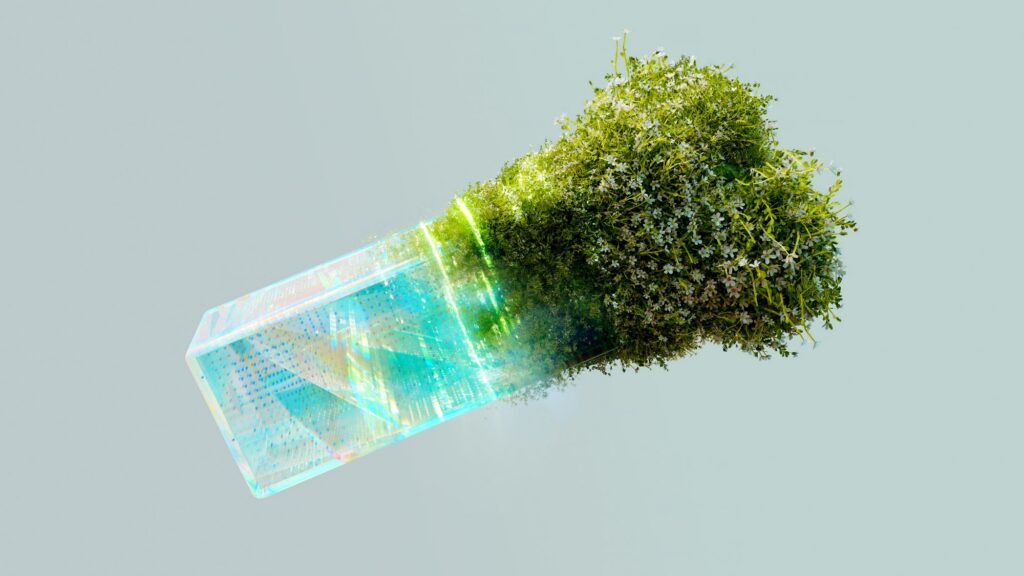
The Evolution: Beyond “PVC-Free” to Biond Biopolymers
While transitioning to standard PVC-free materials like polypropylene (PP) is a significant step, the industry is already moving toward a more sophisticated solution. Biond biopolymer print films represent the next phase of this evolution, shifting the focus from simply being “less bad” to being “actively better.”
Veritas Print Media: Bringing the Revolution to You
The transition to a sustainable print industry requires a bridge between cutting-edge technology and the global marketplace. Veritas Print Media is that bridge, working to bring Biond to brands, consumers, and the print industry across the world.
Empowering Global Brands
Veritas works closely with leading global producers to refine Biond films, ensuring they are more transparently sustainable than traditional PVC. This allows brands to align their physical marketing with their ESG (Environmental, Social, and Governance) goals, telling a story of integrity from the plant-based origin to the biodegradable finish.
Supporting the Print Industry
The print industry has long been reliant on PVC due to a lack of viable alternatives. Veritas is changing that narrative by providing high-performance media that fits into existing workflows. By global sourcing and collaborating with innovators, Veritas ensures that “green” printing is a practical, high-quality reality for printers everywhere.
Protecting the Consumer
By replacing PVC with Biond, Veritas helps reduce the presence of toxic chemicals in the spaces where we live and shop. When consumers see Biond being used, they are witnessing a tangible shift toward a circular economy where marketing materials no longer leave a permanent scar on the planet.
Closing the Loop
Veritas Print Media is more than a supplier; we are a partner in the industry’s evolution. By championing Biond biopolymers, we are helping the world move past the “Poison Plastic” era and into a future where print media is as renewable as the ideas it promotes.